Hanging car diffusers can leak when the bottle, closure, seals and fragrance liquid do not work well together under the conditions they encounter. Heat, movement and filling level can expose a weakness that is not visible in a new sample standing upright on a desk.
For brands and importers, the useful starting point is to identify how the product holds liquid during transport and how it releases fragrance after opening. Those two states may use different sealing arrangements. This guide focuses on non-electric hanging bottles with wooden covers, including wood-absorption and cotton-wick designs.
Start with the liquid path and the sealing points

A wooden cover can perform different jobs. In a wood-absorption design, fragrance intentionally wets part of the wood to release scent. In a cotton-wick design, liquid travels through the wick; the surrounding structure can be designed to keep it away from the decorative wood.
That distinction changes what buyers should inspect. Intended wetting of an absorbent part is different from liquid escaping onto the bottle exterior, hanging cord or surrounding surfaces. Ask the supplier to show the liquid path and the points intended to stop unwanted flow.
In the designs Green-Life encounters, components may include an injection-moulded inner closure, a stopper, a sealing washer and, for a cotton-wick outlet, a silicone sleeve around the wick opening. Distinguish how the cap assembly connects to the bottle from how a separate inner stopper seats inside the neck; these are different joints and need their own fit checks.
| Area | What buyers should establish |
|---|---|
| Bottle-to-closure joint | Which surface seals, and what holds the closure in position? |
| Stopper or washer | Does it seat evenly, remain retained and suit the fragrance liquid? |
| Wick opening | How is the gap around the wick controlled without preventing the intended feed? |
| Decorative wooden cover | Is it an absorbent scent-release part or a cover isolated from the liquid? |
| Transport seal | Which parts remain fitted during shipping, and what changes at first use? |
A “double seal” description is useful only when the supplier identifies both sealing points and demonstrates how they work in the assembled product.
Check the bottle and closure as a matched set
Matching the apparent opening diameter is only a first check. Closure specifications also describe the neck finish, including details of the threads and neck height.[1] For a washer sealing against the rim, check the contact surface for flatness and damage. For a stopper sealing inside the neck, check the bore dimensions, profile and contact around the stopper. Inspect the actual sealing area for grooves, ridges or other irregularities, and confirm that the parts seat fully.
For threaded cap assemblies, establish and verify an application-torque range for the actual combination. Excessive tightening can damage threads or components, while insufficient tightening can leave the closure loose and allow leakage.[2] With push-fit designs, focus on seating depth and retention. Neither should depend solely on an operator deciding that the fit “feels tight.”
Ask for the dimensions and tolerances that control the fit, then check representative assembled samples. Small variations in the bottle, insert and seal can combine to change the final contact. When components come from different suppliers, assign responsibility for confirming the complete assembly.
Wood also changes dimension as its moisture content changes, with different movement across and along the grain.[3] Check the wooden cover and its connection to any plastic insert after relevant environmental exposure, looking for cracks, looseness or changed fit. Set moisture and appearance requirements for the selected wood and intended conditions.
Why heat and movement reveal leaks

Green-Life has encountered leakage during transport and while diffusers hang in vehicles exposed to summer sunlight. These are useful conditions to include when planning validation.
In a closed rigid bottle, warming liquid expands and reduces the gas space above it. This can increase internal pressure and place more demand on the closure. The liquid formulation, initial filling temperature and remaining headspace all affect the result.[4] A small amount of empty space is therefore a functional part of the package.
Temperature also matters to the sealing components. Material selection should consider the contact liquid as well as operating temperature; dimensional design must allow for effects such as thermal expansion and seal swelling.[5] A description such as “silicone stopper” or “heat-resistant gasket” is not enough to establish suitability for a particular fragrance blend. Ask for the material grade and verify the assembled system with the intended liquid, checking changes in dimensions, flexibility and sealing contact after exposure.
Movement adds another challenge: liquid reaches openings and joints that may stay dry when the bottle is upright. If leakage appears after exposure, locate the first wet area before replacing components. Check whether it starts at the bottle joint, around a stopper, at the wick opening or through an intentionally absorbent part. Fragrance may also migrate along a wettable narrow gap or cord fibers through capillary action.[6] Follow the wetting path rather than assuming every hot-weather leak comes from a softened stopper.
Leakage can damage surrounding surfaces as well as waste fragrance. Depending on the formulation and surface material, contact can mark or damage finishes; some plastics are susceptible to chemical stress cracking.[7] Include clear instructions to prevent spills and contact with vehicle trim.
In a cotton-wick design, check air replacement as well as liquid delivery. As liquid leaves a rigid reservoir, inadequate air entry can create underpressure that restricts feeding. Ask the supplier how the design admits air while limiting unwanted liquid escape, then evaluate both functions after activation.[8] A dedicated open hole is not the only possible solution.
Specify fill volume and usable headspace
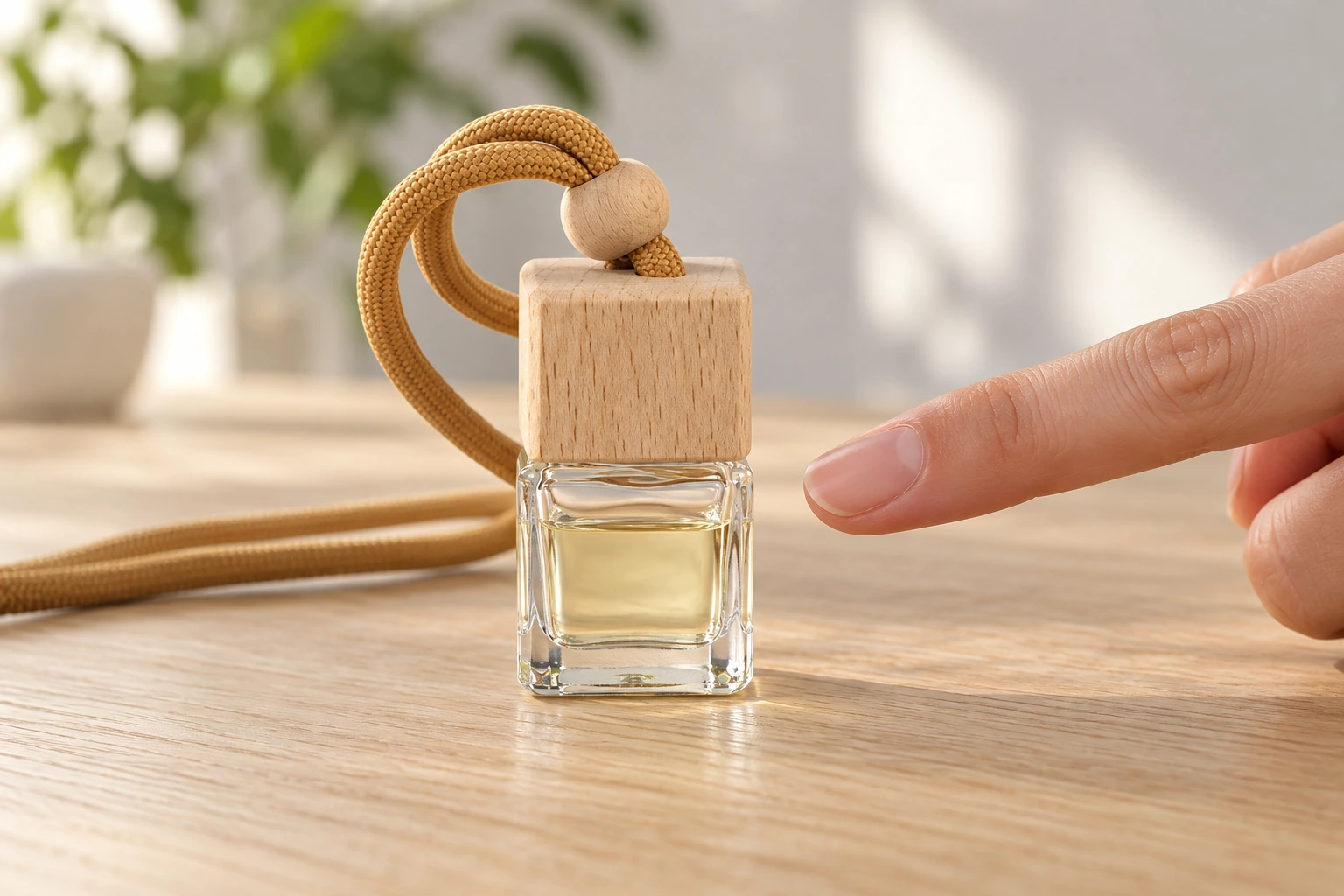
Distinguish the bottle’s brimful capacity—the volume up to its opening—from the amount of fragrance sold in it. Check the usable headspace after the stopper, insert and wick assembly are fitted, accounting for their actual displacement inside the bottle.
Green-Life uses approximately 70%–85% of brimful capacity as an experience-based reference when discussing filling levels for these products. Treat this as a starting point for development: the final fill volume needs validation with the actual liquid, closure and expected temperature conditions.
For purchasing, record the target fill quantity, its permitted variation and the filling conditions. Check samples at the upper permitted fill level, where less headspace remains. If a brand requires a fixed quantity of fragrance, choose a bottle that accommodates it with suitable space rather than filling a smaller bottle to the rim.
Test transport and use separately

Appearance inspection and static leak checks answer useful questions, but they do not show how the product will perform after repeated temperature changes or distribution handling. Build the checks around the product states that buyers will actually receive and use.
For unopened transport samples, use the intended liquid, fill quantity, closure and final packaging. Sideways or inverted static checks can help reveal gross leaks where appropriate to the test plan. Select vibration, drop and environmental exposure conditions to reflect the distribution route. For air freight or high-altitude routes, also assess whether reduced-pressure testing is needed; ASTM D6653 addresses altitude-related pressure differences in packaging systems.[9] ISTA notes that parcel orientation is not guaranteed and recommends selecting tests with knowledge of the actual distribution environment.[10]
For activated use samples, follow the proposed opening and activation instructions, including which stopper is removed, retained or replaced. Assess the assembled hanging product through agreed temperature cycles and representative movement. For cotton-wick designs, include the wick outlet and sleeve; for wood-absorption designs, assess the intended wetting and whether liquid travels beyond it. Transport results cannot substitute for these checks after the sealing arrangement changes.
Before testing, agree the temperatures, exposure times, cycle count, sample quantity and acceptance criteria. After exposure, examine the leakage location, closure retention, component condition and fragrance delivery. A reduction in mass in an active diffuser can include normal evaporation, so weight change should be considered alongside visible wetting and the test conditions.
Green-Life’s experience includes appearance checks and sideways or inverted static leak checks, with additional temperature cycling and transport simulation proposed according to the project. Keep development validation separate from routine production inspection: each has a different purpose, and neither alone establishes long-term performance.
Turn the approved sample into a production specification
Sample approval should identify the complete combination: bottle and neck specification, inner closure, stopper or washer, wick and sleeve where fitted, fragrance formulation, fill quantity and assembly method. Keep photographs or a simple section drawing showing the sealing points and the transport configuration.
Include the agreed checks and acceptance criteria in the production instructions. If the liquid, seal material, bottle supplier, wick or closure changes, review which fit, compatibility and performance checks need repeating. Packaging changes should also prompt a review of transport validation.
For an empty-bottle order, agree who will carry out final validation with the filled product. For a filled-product order, make that confirmation part of the assembled-product approval. This gives the buyer a practical basis for comparing suppliers and accepting production beyond the appearance of the wooden cover.
To discuss a project with Green-Life, share the proposed bottle and closure, the fragrance liquid, target fill quantity and intended market. These provide a useful starting point for agreeing samples and checks.
Quellen
[1] Berlin Packaging — Cap Size & Liner Definitions. https://www.berlinpackaging.com/cap-sizer-liner-definitions/ ↩
[2] Industrial Physics — Torque Testing Guide. https://industrialphysics.com/knowledgebase/articles/torque-testing-guide/ ↩
[3] USDA Forest Products Laboratory — Moisture Relations and Physical Properties of Wood. https://research.fs.usda.gov/treesearch/62243 ↩
[4] Cetie — Headspaces. https://cetie-standard.com/78-article-headspaces ↩
[5] Parker Hannifin — O-Ring Selector / Calculator. https://discover.parker.com/ORingSelector_en ↩
[6] OpenStax — Surface Tension and Capillary Action. https://openstax.org/books/college-physics-2e/pages/11-8-cohesion-and-adhesion-in-liquids-surface-tension-and-capillary-action ↩
[7] Covestro — Makrolon: The Chemical Resistance. https://solutions.covestro.com/-/media/covestro/solution-center/whitepapers/makrolon—the-chemical-resistance.pdf ↩
[8] Gore — FAQ for GORE Packaging Vents. https://www.gore.com/resources/faq-gore-packaging-vents ↩
[9] ASTM International — D6653/D6653M-13(2021): Effects of High Altitude on Packaging Systems. https://store.astm.org/d6653_d6653m-13r21.html ↩
[10] ISTA — Getting Started with Design & Testing. https://www.ista.org/getting_started_with_design.php ↩